

Parquet oil or parquet lacquer: differences in cleaning and care
Oiled and lacquered parquet can look very similar. However, the two surfaces must be treated differently when it comes to cleaning, maintenance, and renovation. An unsuitable product can cause streaks, shiny spots, sticky residues, or difficulties during subsequent refurbishment.
Parquet oil, maintenance oil, polish, and parquet lacquer are particularly often confused with one another. A maintenance oil is intended for a suitable oiled wood surface. In contrast, a polish is used on lacquered or sealed floors approved for such products. These products fulfill different tasks and cannot be exchanged for one another at will.
How do oiled and lacquered parquet differ?
Oiled parquet
Parquet oil penetrates the upper layer of the wood and saturates the wood pores. Unlike a lacquer, a classic parquet oil does not form a completely closed coating on the surface. As a result, the structure, grain, and pores of the wood remain more perceptible.
The oil treatment can diminish over time due to usage and regular cleaning. Frequently used walkways or areas in front of doors may then appear drier, lighter, or duller than the rest of the surface. If necessary, the surface can be refreshed with a maintenance oil that is compatible with the existing oil or hard wax oil system.
Lacquered or sealed parquet
Parquet lacquer forms a cohesive coating on the wood. Dirt and moisture therefore first encounter the lacquer surface and not the open wood pores directly.
As long as this coating is intact, regular maintenance focuses primarily on cleaning the surface. If the floor becomes duller over time, a suitable polish or refresher may be an option for an occasional refresh, depending on the lacquer system.
However, such a maintenance treatment does not replace a damaged lacquer layer or one that has been worn down to the wood.
How do I recognize whether my parquet is oiled or lacquered?
Definitive identification is not always possible based on appearance alone. Very matte lacquers can resemble an oiled floor. Conversely, a regularly maintained or polished oil surface can develop a slight sheen.
Therefore, check the following if possible:
- Invoice, installation documents, or product designation of the floor
- Existing cleaning and maintenance instructions
- Previously used care products
- Any remaining containers of the original surface treatment
- Information from the installation company or the previous owner
Water droplet or scratch tests do not lead to a clear result for every floor and can leave visible marks. If in doubt, the surface should be professionally assessed before any maintenance or renovation work.
Properly cleaning oiled parquet
For the regular cleaning of an oiled floor, a cleaner expressly intended for this purpose should be used. It must match the existing oil, hard wax oil, or oil-wax system. For naturally oiled or color-oiled floors, for example, G² Natural Wood Floor Soap is suitable.
First, remove loose dirt with a suitable vacuum cleaner attachment or a soft broom. Then, clean the floor with a damp (not wet) mop that has been wrung out well. Standing water should be avoided, and spilled liquids should be wiped up promptly.

Important instructions for oiled floors
- Do not use cleaners intended exclusively for sealed parquet
- Do not work with excessive amounts of water
- Do not use aggressive all-purpose cleaners or scouring agents
- Dose cleaning agents according to the instructions for use
- Do not apply arbitrary film-forming care products
- Test new products on an inconspicuous area first
When does oiled parquet need a maintenance oil?
A parquet maintenance oil is not intended for cleaning every time you mop. It can be used if the existing oil surface has become dry, uneven, or visibly duller in frequently used traffic areas.
The maintenance oil can resaturate the upper wood layer and refresh the existing surface treatment. A prerequisite is that the product is compatible with the parquet oil or hard wax oil already used. For suitably natural oiled floors, for example, G² Natural Maintenance Oil is available.
Before re-oiling, the floor must be cleaned and prepared according to the product specifications. Dirt, grease, unsuitable old care products, or areas with varying degrees of wear can influence the result.
Application quantity, processing, polishing, drying, and the time before reuse depend on the instructions for use of the maintenance oil being used.

Tip: Do not simply treat a dry individual spot with a large amount of oil. Varying absorbency can lead to visible differences in color or gloss. Apply to a test area first.
Properly cleaning lacquered parquet
For lacquered or sealed parquet, a dedicated parquet cleaner is required. A ready-to-use Bona Parquet Cleaner can be used for the regular cleaning of appropriately suitable lacquered or sealed wooden floors.
The decisive factor is not just the term "parquet cleaner," but the explicit suitability for the existing coating. Therefore, observe the information regarding the respective product and the corresponding instructions for use.
A lacquered surface should also only be cleaned with a damp (not wet) mop. Water can penetrate the wood through open joints, edges, or already damaged areas. Sand and small stones should be removed before mopping, as they can act like abrasive particles under shoes or cleaning equipment.

When does lacquered parquet need a polish?
If an intact lacquer surface appears dull or shows light signs of wear, a suitable polish or refresher may be considered. The care product forms an additional protective layer over the existing seal.
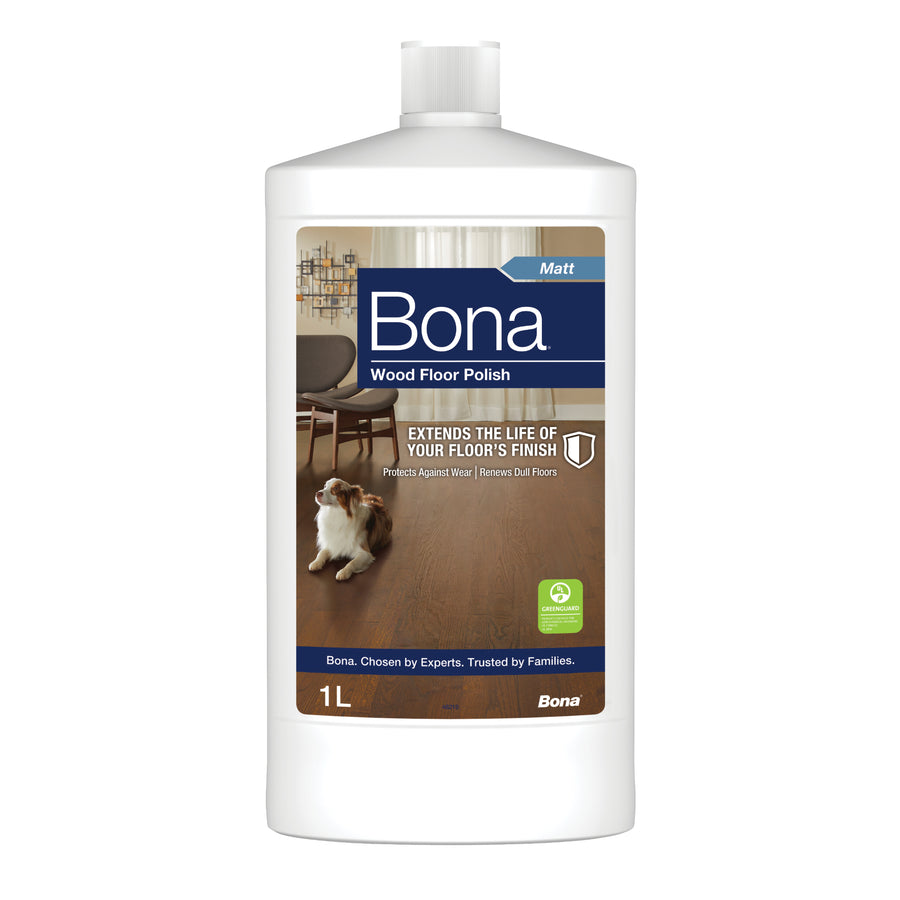
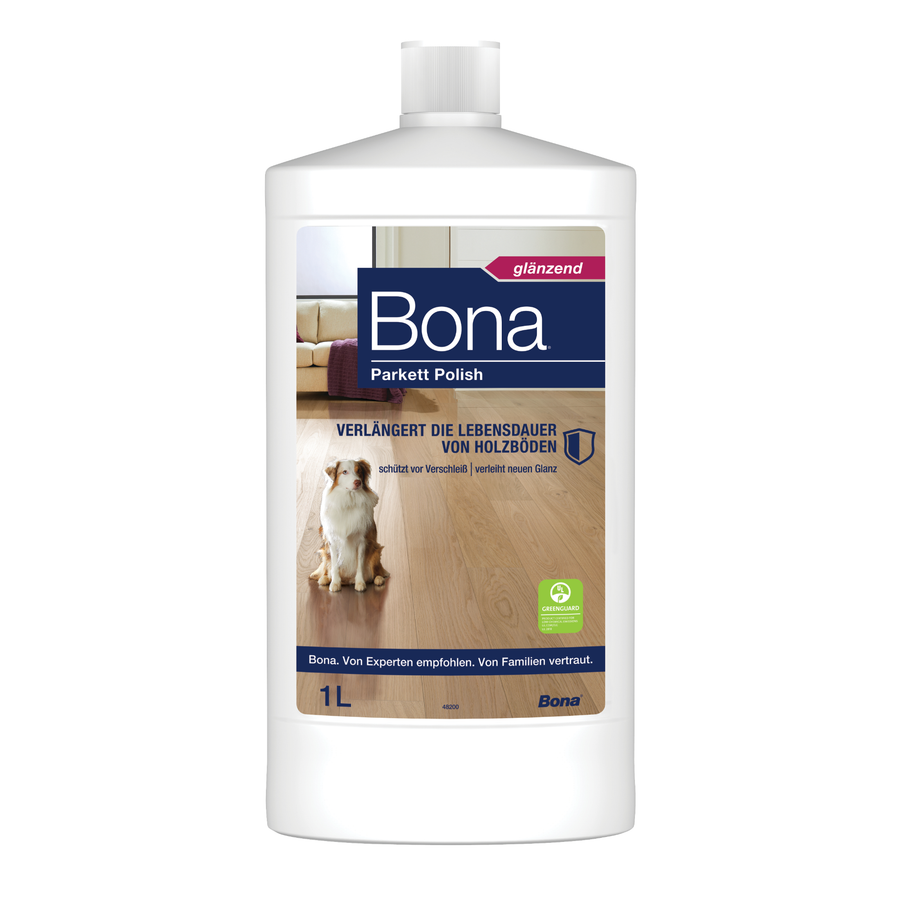
For suitable matte lacquer surfaces, for example, Bona Parquet Polish matte can be used. For appropriately suitable glossy surfaces, Bona Parquet Polish glossy is available.
The care product must match both the existing floor surface and the desired degree of gloss. Before applying to the entire area, a test on an inconspicuous spot is recommended. Preparation, application quantity, processing, and drying times can be found in the instructions for use of the respective product.
A polish must not be confused with parquet lacquer. It does not replace a damaged seal and is not suitable for repairing deep scratches, peeling lacquer layers, or areas worn down to the wood.
The most common mistakes in parquet care
Polish on oiled parquet
A polish intended exclusively for lacquer surfaces can form an unsuitable film on an oiled floor. The result can be uneven and make subsequent oil maintenance or renovation difficult.
Maintenance oil on lacquered parquet
An intact lacquer layer prevents maintenance oil from penetrating the wood evenly. The oil remains on the coating and can cause a greasy, sticky, or patchy surface.
Too much water
Both oiled and lacquered parquet should only be cleaned with a damp (not wet) mop. Especially at joints, edges, and damaged areas, penetrating moisture can lead to changes in the wood.
Overdosing the cleaner
A higher dosage does not automatically lead to a better cleaning result. Residues can cause streaks or sticky areas where new dirt becomes visible more quickly.
Care without thorough cleaning
If maintenance oil or polish is applied over dirt, grease, or unsuitable old care films, these can become trapped under the new care layer. Possible consequences include stains, adhesion problems, or an uneven degree of gloss.
Unchecked switching between different care systems
Products from different systems are not automatically compatible with one another. This is especially true for unknown past treatments. Before changing products, the existing surface and the information provided by the intended care products should be checked.
Can oiled wood be lacquered?
Oiled parquet can generally be converted to a suitable lacquer system. However, the parquet lacquer should not simply be applied to the existing oil surface.
Oil residues can impair the wetting and adhesion of the lacquer. Therefore, for a conversion, the previous surface treatment must generally be sanded off completely. Subsequently, the substrate, the type of wood, and the suitability of the intended primer and lacquer system must be checked.
The depth of sanding required depends, among other things, on which oil was used and how far it has penetrated into the wood. Remaining oil residues can influence the result of a later lacquering.
Engineered parquet cannot be sanded an infinite number of times
With engineered parquet or multi-layer parquet, the thickness of the remaining wear or top layer must be checked before any renovation. This consists of the visible precious wood and, depending on the product, is often only a few millimeters thick.
No generally valid number of possible sanding passes can be derived from this. The deciding factors include, among others:
- Original thickness of the wear layer
- Renovations already carried out
- Previous material removal
- Depth of existing scratches and damage
- Flatness of the surface
- Type of sanding method required
- Construction of the parquet elements
If the wear layer is too thin or already reduced by previous renovations, another full sanding pass could damage the floor structure. The wear layer thickness should therefore be checked in the product documents or professionally assessed before the start of work.
The fact that engineered parquet is generally renovatable does not mean that every floor can be sanded down an unlimited number of times.
Can lacquered parquet be oiled later?
Switching from lacquer to oil also requires the closed lacquer layer to be completely removed. The oil can only penetrate the wood evenly if the pores are free and the surface has been sanded professionally.
Simply sanding the lacquer surface is usually not sufficient for this. Remaining lacquer residues can lead to uneven oil absorption and visible color differences.
In the case of multi-layer parquet, it must also be checked during this conversion whether the remaining wear layer is sufficient for the necessary processing.
Parquet oil or parquet lacquer: Which surface is better?
Neither of the two surfaces is fundamentally better suited for every room and every use. The decision depends on the desired appearance, the specific surface system, and the willingness to perform ongoing maintenance.
Oiled parquet may suit you if you:
- Prefer an immediate, wood-like look with little film formation
- Want to perceive the wood structure clearly
- Are willing to touch up the surface with a suitable maintenance oil when necessary
- Want to have local signs of wear treated in a targeted manner, given a suitable floor structure
Lacquered parquet may suit you if you:
- Desire a closed coating on the wood surface
- Want to limit regular maintenance primarily to cleaning and occasional refreshing
- Want to choose between matte, silk-matte, and glossy surfaces
- Want to use a coordinated lacquer and care system
How durable a surface actually is depends on the specific oil, hard wax oil, or lacquer system, the floor structure, and the professional application.
Cleaning and maintenance at a glance
Oiled parquet
- Vacuum or sweep away loose dirt.
- Wipe with a damp (not wet) mop using a cleaner suitable for the oiled surface.
- Regularly check the floor for dry or heavily used areas.
- Treat with a compatible maintenance oil or oil refresher if necessary.
- Observe the application quantity, drying, and usage instructions for the respective product.
Lacquered parquet
- Remove loose dirt carefully.
- Wipe with a damp (not wet) mop using a suitable cleaner for sealed parquet.
- Do not apply maintenance oil to the closed lacquer surface.
- Refresh a dull but intact surface with a suitable polish or refresher if necessary.
- Have damaged areas or those worn down to the wood professionally assessed.
Conclusion: The existing surface determines the right care
Oiled parquet requires cleaners tailored to it and, if necessary, a suitable maintenance oil. Lacquered parquet is cleaned with a cleaner for sealed wooden floors and, if the coating is intact, can occasionally be refreshed with a matching polish or refresher.
The most common mistake is mixing the two maintenance systems. Therefore, do not apply a polish intended for lacquered surfaces to oiled parquet, nor apply maintenance oil to an intact lacquer layer.
In cases of unknown previous treatment, deeper damage, or a planned switch from oil to lacquer, the surface should be professionally assessed. For pre-finished parquet, it must also be checked whether the remaining wear layer is sufficient for the required processing.
A selection of suitable cleaners, maintenance oils, polishes, and other products can be found in our overview of parquet surface treatment.
Frequently asked questions about parquet oil and parquet lacquer
FAQ
What is the most important difference between parquet oil and parquet lacquer?
Parquet oil penetrates the upper layer of the wood and saturates the wood pores. Parquet lacquer, on the other hand, forms a cohesive coating on the wood surface. Therefore, oiled and lacquered floors require different cleaning and maintenance products.
Can I use a standard parquet cleaner on oiled parquet?
A parquet cleaner can be used on oiled parquet if the specific product is expressly suitable for the existing oiled surface. Check the product information, test on a sample area, and follow the instructions for use.
How often does oiled parquet need to be re-oiled?
A general time frame cannot be specified. The need for maintenance depends, among other things, on the wear and tear, cleaning, wood species, and the existing oil system. Check the condition of the surface and follow the instructions for the maintenance oil.
Can I use polish on oiled parquet?
A polish intended exclusively for lacquered or sealed floors should not be used on oiled parquet. It can form an unsuitable maintenance film and make future oil maintenance difficult. Therefore, always check the product's surface compatibility.
Can maintenance oil be used on lacquered parquet?
Maintenance oil is not intended for an intact lacquered surface. The closed coating prevents the oil from penetrating the wood evenly. It may remain on the surface and cause greasy, sticky, or patchy areas.
Can oiled parquet be lacquered directly?
Parquet lacquer should not be applied directly to an existing oil surface. Oil residues can impair the wetting and adhesion of the lacquer. As a rule, the previous treatment must be completely removed and the intended lacquer system professionally verified.
Can lacquered parquet be oiled later?
Before oiling, the closed lacquer layer must be completely removed. Remaining lacquer residues can prevent the oil from penetrating the wood evenly. For pre-finished parquet, it must also be checked whether the remaining wear layer is sufficient for the necessary processing.
Can any pre-finished parquet be sanded down multiple times?
Pre-finished parquet cannot be sanded down indefinitely. The decisive factors are the original and remaining wear layer, previous renovations, and the necessary material removal. Check the product documentation or have the floor professionally assessed before sanding.
Which is easier to maintain: oiled or lacquered parquet?
Lacquered parquet is mainly cleaned in everyday life via the closed coating. Oiled parquet requires additional maintenance with a suitable oil, depending on usage and surface condition. Which surface is better depends on the desired look and the willingness to perform maintenance.

